



1. Introduction: Understanding Vimshottari Dasha
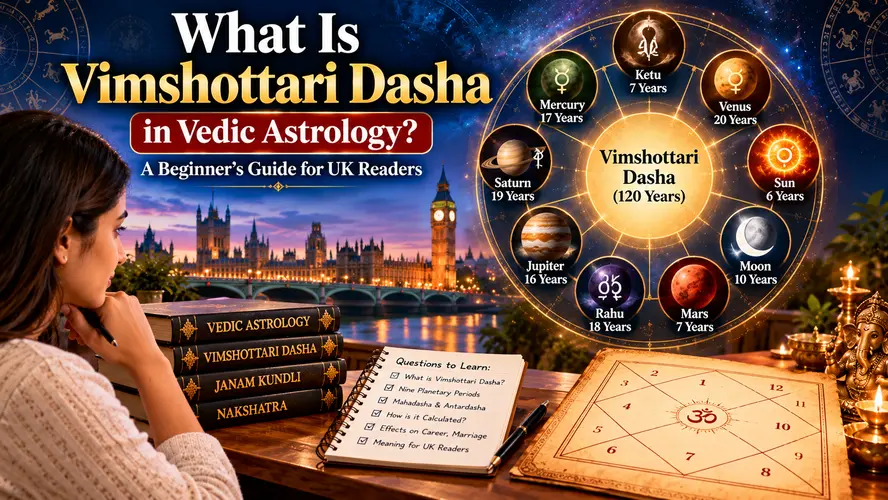
Vimshottari Dasha is one of the best-known planetary-period systems used in traditional Vedic astrology. It divides a symbolic 120-year cycle into periods associated with nine planetary rulers.
2. What Is Vimshottari Dasha?
- Vimshottari Dasha: A traditional Vedic astrology system that assigns periods of time to nine planetary rulers.
- 120-year cycle: The complete sequence adds up to 120 years.
- Mahadasha: The main planetary period.
- Antardasha: A sub-period within a Mahadasha.
- Birth Nakshatra: The Moon’s Nakshatra at birth is used to determine the starting planetary period and the balance remaining.
3. The Nine Planetary Periods
The traditional Vimshottari Dasha sequence contains nine periods:
- Ketu — 7 years: Traditionally associated with detachment, reflection and spiritual inquiry.
- Venus (Shukra) — 20 years: Associated in traditional interpretations with relationships, art, comfort and material enjoyment.
- Sun (Surya) — 6 years: Associated with authority, confidence, leadership and responsibility.
- Moon (Chandra) — 10 years: Associated with emotions, family, care and the mind.
- Mars (Mangal) — 7 years: Associated with initiative, energy, courage and action.
- Rahu — 18 years: Associated with ambition, unusual experiences, material pursuits and change.
- Jupiter (Guru) — 16 years: Associated with learning, wisdom, growth and guidance.
- Saturn (Shani) — 19 years: Associated with discipline, duties, patience and long-term effort.
- Mercury (Budh) — 17 years: Associated with communication, reasoning, business and learning.
The period lengths total 120 years. The meanings listed above are traditional associations and should not be taken as guarantees of particular experiences.
4. What Is Mahadasha?
Mahadasha is the main planetary period in the Vimshottari Dasha system.
- Each Mahadasha has a traditional duration assigned to its ruling planet.
- The sequence follows the established order of the nine planetary rulers.
- Astrologers interpret a Mahadasha by considering the relevant planet’s position and role in the birth chart.
- The same Mahadasha may be interpreted differently in different charts.
A Mahadasha should not be interpreted by its planet name alone. Traditional readings also consider the Ascendant, houses, planetary relationships and other chart factors.
Want to Understand Your Vimshottari Dasha?
Traditional Vedic Astrology Guidance • Online Consultation • UK & Worldwide
5. What Is Antardasha?
Antardasha is a sub-period within a Mahadasha.
- Each Mahadasha contains a sequence of nine Antardashas.
- The sub-periods follow the Vimshottari planetary order.
- Their durations depend on the standard period lengths of the two planetary rulers.
- Traditional astrologers consider both the Mahadasha and Antardasha when discussing a particular period.
6. What Is Pratyantardasha?
Pratyantardasha is a smaller sub-period within an Antardasha.
- Mahadasha: Main planetary period.
- Antardasha: Sub-period within the main period.
- Pratyantardasha: A further subdivision used in more detailed traditional timing calculations.
Some practitioners examine these smaller periods when discussing specific time windows. More detailed calculations do not guarantee that a particular event will occur.
7. How Is Vimshottari Dasha Calculated?
Traditional Vimshottari Dasha calculations use the Moon’s position at birth.
The process generally involves:
- Calculating the Moon’s position from the date, time and place of birth.
- Identifying the Nakshatra occupied by the Moon.
- Determining the planetary ruler associated with that Nakshatra.
- Calculating the remaining portion of the starting Mahadasha.
- Working out subsequent planetary periods and sub-periods in sequence.
8. Why Is Birth Nakshatra Important?
Birth Nakshatra has a central role in the standard Vimshottari Dasha method.
- Each Nakshatra is associated with a planetary ruler.
- The Moon’s position within the Nakshatra helps determine the balance of the first Mahadasha.
- A different calculated Moon position may change the starting balance.
- If the Moon is close to a Nakshatra boundary, birth-time uncertainty may affect the calculation.
This is why the date, time and place of birth should be checked carefully before relying on a Dasha timetable.
Want to Understand Your Vimshottari Dasha?
Traditional Vedic Astrology Guidance • Online Consultation • UK & Worldwide
9. How Do Astrologers Traditionally Interpret a Mahadasha?
In traditional Vedic astrology, practitioners may consider several factors:
- Planetary ruler: Which planet governs the current period.
- House placement: Where that planet is positioned in the birth chart.
- House rulership: Which houses the planet rules for the particular Ascendant.
- Planetary relationships: Connections with other planets in the chart.
- Antardasha ruler: The planet associated with the current sub-period.
- Other chart factors: Some practitioners also consider transits and divisional charts.
10. Common Mistakes to Avoid
When learning about Vimshottari Dasha, avoid these common mistakes:
- Assuming every person experiences a planetary period in the same way.
- Interpreting a Mahadasha using only the planet’s name.
- Ignoring birth-time uncertainty.
- Confusing Mahadasha with Antardasha.
- Treating a Dasha timetable as a guarantee of future events.
- Paying for expensive remedies because of fear-based claims.
- Making important life decisions solely on an astrological interpretation.
Want to Understand Your Vimshottari Dasha?
Traditional Vedic Astrology Guidance • Online Consultation • UK & Worldwide
11. Frequently Asked Questions
It is a traditional planetary-period system based on a 120-year sequence of nine planetary rulers. The Moon’s birth Nakshatra is used to determine the starting period.
The system uses nine planetary rulers: Ketu, Venus, Sun, Moon, Mars, Rahu, Jupiter, Saturn and Mercury.
Mahadasha is the main planetary period, while Antardasha is a smaller period within it.
The sequence is calculated from the Moon’s birth Nakshatra. The first Mahadasha begins according to that Nakshatra, and only the remaining balance may be left at birth.
No. It is part of a traditional astrological system and is not scientifically established as a method for predicting individual life events.




Leave a Reply