


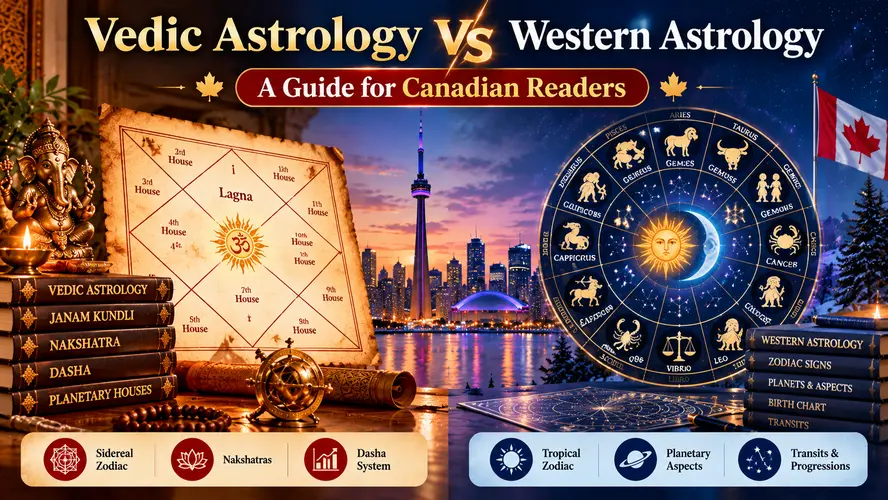

Astrology is a subject of interest for many people in Canada, including families with Indian heritage and readers exploring different cultural traditions. Two widely discussed systems are Vedic astrology, also known as Jyotish, and Western astrology.
1. What Is Vedic Astrology?
- Vedic astrology, traditionally called Jyotish, developed within the Indian astrological tradition.
- It commonly uses the sidereal zodiac, which relates zodiac calculations to the positions of constellations.
- A Vedic birth chart, often called a Janam Kundli, maps planetary placements at the time and place of birth.
- Traditional readings may examine the Lagna (Ascendant), Moon sign, Nakshatras, planetary houses, and Dasha periods.
- People may consult Vedic astrology for traditional perspectives on relationships, career, family life, and personal development.
2. What Is Western Astrology?
- Western astrology developed through several historical traditions, including ancient Greek and later European practices.
- Many modern Western astrologers use the tropical zodiac, which is aligned with the seasonal cycle.
- Western birth charts commonly interpret the Sun sign, Moon sign, Ascendant, planets, houses, and aspects.
- Psychological themes, personality, emotional patterns, and personal growth are common focuses in contemporary Western astrology.
- Different Western astrologers use different methods, so not every reading follows the same approach.
3. The Main Difference: Sidereal and Tropical Zodiacs
- One of the best-known differences is the zodiac framework used to calculate planetary positions.
- Vedic astrology commonly uses the sidereal zodiac.
- Most modern Western astrology uses the tropical zodiac.
- Because the systems use different reference points, a person’s zodiac sign may differ between the two systems.
- A difference in sign does not necessarily mean that one chart is incorrect; the systems are using different conventions.
- Readers should check which zodiac system a chart calculator or astrologer uses before comparing results.
4. Vedic Astrology vs Western Astrology: Key Differences
- Zodiac system: Vedic astrology generally uses the sidereal zodiac, while Western astrology commonly uses the tropical zodiac.
- Chart interpretation: Vedic readings often place substantial emphasis on the Lagna, Moon sign, Nakshatras, and planetary periods.
- Common Western emphasis: Many Western readings focus on the Sun sign, Moon sign, Ascendant, planetary aspects, and psychological interpretation.
- Timing techniques: Vedic astrology commonly uses Dasha systems, including Vimshottari Dasha. Western astrology may use transits, progressions, and other timing methods.
5. What Is a Vedic Birth Chart or Janam Kundli?
- A Janam Kundli is a chart prepared using a person’s birth date, birth time, and birthplace.
- The Lagna, or Ascendant, represents the zodiac sign rising on the eastern horizon at the recorded birth time.
- The twelve houses are traditionally associated with different areas of life.
- Nakshatras divide the zodiac into 27 lunar mansions in the commonly used Vedic system.
- Planetary placements and Dasha periods may be interpreted together rather than treating one placement as a complete prediction.
6. What Is a Western Birth Chart?
- A Western natal chart is also calculated using birth date, time, and location.
- It usually displays the Sun, Moon, planets, zodiac signs, houses, and aspects.
- The Sun sign is only one part of the chart; the Moon sign and Ascendant are also commonly discussed.
- Many contemporary Western interpretations explore temperament, motivations, relationships, and personal development.
7. Which System Should Canadians Choose?
- Readers interested in Indian astrological traditions may wish to explore Vedic astrology.
- People familiar with Sun-sign horoscopes and modern psychological interpretations may prefer Western astrology.
- Those exploring family customs, Nakshatras, or traditional Kundli matching may find Vedic methods more relevant to their interests.
- Readers interested in personality themes through planetary aspects may prefer a Western-style reading.
8. Why Accurate Birth Details Matter in Canada
- Canada spans multiple time zones, so the birthplace and local birth time are important.
- Provide the city or town where the birth occurred, not simply the current city of residence.
- If your birth record uses a local time, share that recorded time and mention any uncertainty.
- Historical time-zone and daylight-saving rules can affect chart calculations.
- If the birth time is approximate, tell the astrologer rather than presenting it as exact.
9. Questions to Ask Before Booking an Astrology Consultation
- Do you use Vedic astrology, Western astrology, or both?
- Which zodiac system will you use for my chart?
- What birth details do you need?
- Will you explain the chart terminology in simple language?
- What is included in the consultation and what is the fee?
- How will my personal birth details be handled?
- Can I receive a written summary of the interpretation?
10. Explore Traditional Vedic Astrology with Shivdham Astrologer
If you are interested in learning about Vedic astrology, a consultation can provide an explanation of traditional chart concepts such as the Lagna, Moon sign, Nakshatras, planetary placements, and Dasha periods.
Shivdham Astrologer, associated with Pandit Dharm Raj, offers astrology consultation services for people interested in traditional Vedic astrology. Before booking, ask about the service offered, fees, required birth details, and what the consultation includes.
Important note: Astrology is a cultural and spiritual tradition, not a scientifically proven method for predicting outcomes. Use it as a source of personal reflection rather than a substitute for professional medical, financial, legal, or relationship advice.
11. Frequently Asked Questions
No. Both interpret celestial positions, but they commonly use different zodiac systems and may emphasize different chart factors and timing methods.
The systems commonly use different zodiac frameworks: sidereal in Vedic astrology and tropical in Western astrology. This can produce different sign placements.
Some Indian families in Canada consult Vedic astrology for traditional purposes, including birth-chart interpretation and marriage compatibility. Individual beliefs and practices vary.
Usually, the birth date, birth time, and birthplace are needed. A more precise birth time helps calculate the Ascendant and houses.
There is no strong scientific evidence establishing either astrological system as a reliable way to predict personal outcomes. The choice usually depends on cultural background, interest, and the type of interpretation a reader wants.




Leave a Reply