



1. Introduction: Understanding Nakshatra in Vedic Astrology
Nakshatras are an important part of traditional Vedic astrology. Many Indian families use the concept of Nakshatra when discussing birth charts, naming ceremonies, marriage compatibility and auspicious timings.
2. What Is a Nakshatra?
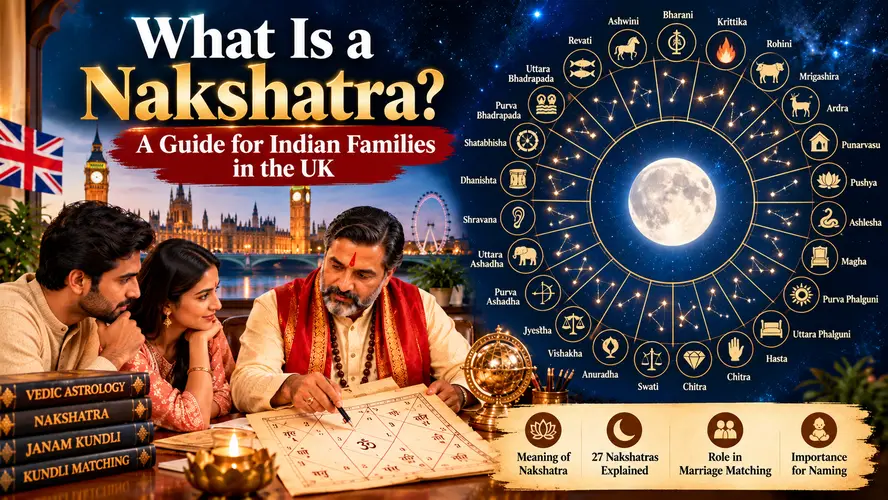
- A Nakshatra is one of the 27 lunar divisions used in traditional Vedic astrology.
- The system divides the zodiac into 27 sections of approximately 13 degrees and 20 minutes each.
- The Moon’s position in the zodiac is used to determine a person’s birth Nakshatra.
- Each Nakshatra has a traditional name, symbol, ruling planet and associated interpretations.
- Nakshatras are used alongside Rashi, Lagna and other factors when interpreting a Janam Kundli.
3. What Are the 27 Nakshatras?
The traditional list of 27 Nakshatras is:
- Ashwini
- Bharani
- Krittika
- Rohini
- Mrigashira
- Ardra
- Punarvasu
- Pushya
- Ashlesha
- Magha
- Purva Phalguni
- Uttara Phalguni
- Hasta
- Chitra
- Swati
- Vishakha
- Anuradha
- Jyeshtha
- Mula
- Purva Ashadha
- Uttara Ashadha
- Shravana
- Dhanishta
- Shatabhisha
- Purva Bhadrapada
- Uttara Bhadrapada
- Revati
- Some traditions also use Abhijit as an additional Nakshatra for particular calculations. Its use depends on the astrological tradition and purpose.
4. How Is Your Birth Nakshatra Calculated?
A birth Nakshatra is traditionally calculated using these details:
- Date of birth: The day, month and year you were born.
- Time of birth: The most accurate available birth time.
- Place of birth: The town or city and country where you were born.
These details help determine the Moon’s position at the relevant moment. Because the Moon moves through the zodiac, the birth time can matter, particularly when the Moon is close to a Nakshatra boundary.
5. What Is the Difference Between Nakshatra and Rashi?
Nakshatra and Rashi are related concepts, but they are not the same.
- Nakshatra: One of the 27 lunar divisions in the traditional system.
- Rashi: One of the 12 zodiac signs.
- Birth Nakshatra: Determined by the Moon’s position within a Nakshatra.
- Moon sign or Chandra Rashi: Determined by the zodiac sign occupied by the Moon.
6. Why Is Nakshatra Important in Traditional Vedic Astrology?
Nakshatras are traditionally considered in several areas of astrology:
- Janam Kundli interpretation: Used as one factor when discussing a birth chart.
- Marriage matching: Certain compatibility systems compare the Nakshatras of prospective partners.
- Naming traditions: Some Hindu naming customs use the birth Nakshatra or its associated syllables.
- Muhurta: Nakshatras may be considered when selecting a traditional auspicious time for an event.
- Dasha calculations: In the Vimshottari Dasha system, the Moon’s Nakshatra at birth is used to calculate the starting planetary period.
- Religious and family customs: Some families observe rituals or traditions associated with a person’s birth Nakshatra.
7. What Is Nakshatra Pada?
Each Nakshatra is divided into four smaller sections called Padas.
- There are four Padas within each of the 27 Nakshatras.
- Each Pada covers approximately 3 degrees and 20 minutes of the zodiac.
- A Pada is used in some traditional interpretations and naming customs.
- The exact Moon position is important when calculating the birth Pada.
8. What Is the Role of Nakshatra in Kundli Matching?
Some traditional Hindu marriage-matching systems compare the Nakshatras of two people as part of a broader compatibility assessment.
Points commonly considered include:
- Ashtakoota matching: A traditional system that evaluates eight compatibility factors.
- Nadi: One of the factors used in some Kundli matching traditions.
- Gana: A traditional classification used in compatibility calculations.
- Yoni: A symbolic category used in certain matching systems.
- Tara or Dina Koota: A factor associated with the relationship between the birth Nakshatras.
9. Can You Find Your Nakshatra Without an Exact Birth Time?
Sometimes, but the result depends on the Moon’s position on the date of birth.
- If the Moon remains within the same Nakshatra throughout the relevant period, the birth Nakshatra may be identifiable even if the exact time is unknown.
- If the Moon changes Nakshatra during that date, a more precise birth time may be needed.
- The Pada may be harder to determine when the exact time is unavailable.
- A date, location and approximate birth time can help narrow down
10. Nakshatra and Naming a Baby
In some Hindu families, a baby’s birth Nakshatra is used as a traditional guide for choosing a starting syllable for the child’s name.
Families may consider:
- The baby’s calculated birth Nakshatra.
- The relevant Pada.
- The traditional syllables associated with that Pada.
- Family, regional and linguistic naming customs.
- The meaning and personal significance of the chosen name.
11. Nakshatra for Indians Living in the UK
Indian families in London, Birmingham, Manchester, Leicester, Glasgow and other UK locations may wish to understand their traditional birth charts while living outside India.
When arranging an online Kundli consultation, consider these practical points:
- Provide the correct date and place of birth.
- Use the local birth time from the place where the person was born.
- Mention if the time is approximate or unknown.
- Ask which calculation method is being used if you are comparing different charts.
- Request an explanation of the result in clear, accessible language.
- Check consultation fees and privacy practices before sharing personal information.
12. How to Find Your Nakshatra Online
To check your birth Nakshatra:
- Find a reputable Vedic birth-chart calculator or consult a practitioner.
- Enter your date of birth.
- Enter your birth time as accurately as possible.
- Select your actual place of birth.
- Review the displayed Moon sign, Nakshatra and Pada.
- If your birth time is uncertain, ask whether the result could change within the possible time range.
13. Common Mistakes to Avoid
When learning about Nakshatras, avoid these common mistakes:
- Confusing the Moon sign with the birth Nakshatra.
- Assuming that a date of birth always provides enough information for an exact Pada.
- Using the current location instead of the actual place of birth.
- Ignoring time zones and daylight-saving changes when calculating historical birth times.
- Treating online descriptions as a complete personal birth-chart interpretation.
- Believing that a Nakshatra alone guarantees a particular marriage, career or life outcome.
Want to Understand Your Birth Nakshatra?
Traditional Vedic Astrology Guidance • Online Consultation • UK & Worldwide
A Nakshatra is one of the 27 lunar divisions used in traditional Vedic astrology. The Moon’s position at birth determines the birth Nakshatra.
The commonly used system has 27 Nakshatras. Some traditions also recognise Abhijit for specific purposes.
No. Nakshatra refers to one of 27 lunar divisions, while Rashi refers to one of the 12 zodiac signs.
Sometimes. If the Moon changes Nakshatra during that date, the birth time may be needed to identify the correct one.
Each Nakshatra is divided into four Padas. These divisions are used in certain traditional interpretations and naming customs.




Leave a Reply