


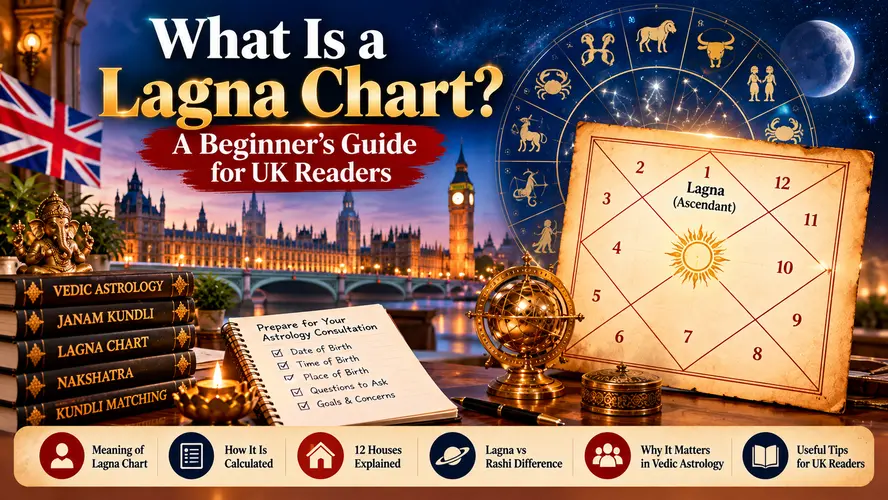

1. Introduction: Understanding the Lagna Chart
The Lagna chart is an important part of traditional Vedic astrology. It is also known as the Ascendant chart or the D1 chart and is prepared using a person’s date, time and place of birth.
2. What Is a Lagna Chart?
- Lagna: The zodiac sign rising on the eastern horizon at the time and place of birth.
- Lagna chart: A traditional Vedic birth chart arranged using the Ascendant as the first house.
- Other name: It is commonly called the D1 chart or Rashi chart in Vedic astrology.
- Main purpose: Practitioners use it as a starting point for interpreting houses, planets and their traditional astrological meanings.
- Birth details: Accurate date, time and place are important for calculating the Ascendant.
3. How Is the Lagna Determined?
The Lagna is calculated using three main details:
- Date of birth: The day, month and year.
- Time of birth: The recorded local birth time, as accurately as possible.
- Place of birth: The town or city and country where the person was born.
The Ascendant changes as the Earth rotates, so the birth time and location matter. In many cases, the rising sign changes approximately every two hours, although the actual duration varies.
4. Why Is the Lagna Chart Important in Vedic Astrology?
Traditional Vedic astrologers use the Lagna chart to discuss several areas:
- The twelve houses: Each house is associated with different traditional themes.
- Planetary placements: The chart shows where planets fall relative to the Ascendant.
- House rulers: Practitioners interpret the planets associated with each house.
- Lagna lord: The planet ruling the Ascendant sign receives particular attention in many interpretations.
- Additional charts: Some practitioners consider divisional charts alongside the main birth chart.
Want to Understand Your Lagna Chart?
Traditional Vedic Astrology Guidance • Online Consultation • UK & Worldwide
5. What Are the Twelve Houses in a Lagna Chart?
In a traditional Vedic birth chart, the twelve houses are commonly associated with the following themes:
- First house: Self, appearance and general disposition.
- Second house: Family, speech and accumulated resources.
- Third house: Communication, initiative and siblings.
- Fourth house: Home, family roots and emotional foundations.
- Fifth house: Learning, creativity and children.
- Sixth house: Daily responsibilities, service and challenges.
- Seventh house: Partnerships and marriage.
- Eighth house: Change, shared resources and hidden matters.
- Ninth house: Beliefs, higher learning and long-distance journeys.
- Tenth house: Career, responsibilities and public role.
- Eleventh house: Networks, aspirations and gains.
- Twelfth house: Retreat, expenses, solitude and foreign connections.
6. What Is the Difference Between Lagna and Rashi?
Lagna and Rashi are related but different concepts.
- Lagna or Ascendant: The sign rising on the eastern horizon at birth.
- Chandra Rashi or Moon sign: The zodiac sign occupied by the Moon at birth.
- Surya Rashi or Sun sign: The zodiac sign occupied by the Sun, according to the system being used.
- Lagna chart: A chart arranged with the Ascendant as the first house.
- Moon-based interpretation: Some traditional readings also examine houses from the Moon sign.
7. What Is the Lagna Lord?
The Lagna lord is the planet that rules the zodiac sign of the Ascendant.
For example, in the commonly used traditional rulership system:
- Aries Lagna: Mars.
- Taurus Lagna: Venus.
- Gemini Lagna: Mercury.
- Cancer Lagna: Moon.
- Leo Lagna: Sun.
- Virgo Lagna: Mercury.
- Libra Lagna: Venus.
- Scorpio Lagna: Mars.
- Sagittarius Lagna: Jupiter.
- Capricorn Lagna: Saturn.
- Aquarius Lagna: Saturn.
- Pisces Lagna: Jupiter.
The Lagna lord’s placement and relationships with other planets are considered in traditional chart interpretation. Different astrological schools may use additional rules or approaches.
8. Can Your Lagna Change?
Your birth Lagna does not change over the course of your life in a natal birth chart. It is calculated for the specific time and place of birth.
However:
- The rising sign changes as time passes.
- An incorrect birth time can produce a different calculated Ascendant.
- A chart calculator may give different results if its time-zone settings or birth details are wrong.
- If the recorded birth time is close to a sign boundary, even a modest time difference may affect the result.
If you are unsure of your birth time, avoid treating an estimated Lagna as certain.
9. What Is the Difference Between a Lagna Chart and a Navamsa Chart?
The Lagna chart and Navamsa chart serve different roles in traditional Vedic astrology.
- Lagna chart or D1: The main natal chart used as a starting point for general interpretation.
- Navamsa chart or D9: A divisional chart traditionally examined for additional detail, particularly in some discussions of marriage and planetary strength.
- Calculation: The Navamsa chart is derived from the planetary positions in the birth chart.
- Birth-time sensitivity: The Ascendant and some divisional-chart details can be sensitive to birth-time accuracy.
10. Can You Calculate a Lagna Chart Online in the UK?
Yes, online birth-chart calculators and astrology services are available to people living in the UK.
Before using one, consider these points:
- Enter the actual place of birth, not your current address.
- Use the recorded local birth time.
- Check the date format to avoid confusing day and month.
- Confirm that the calculator handles the relevant time zone and daylight-saving rules.
- Review which Vedic calculation settings are being used if you compare different results.
- If your birth time is uncertain, treat the Ascendant as provisional.
Want to Understand Your Lagna Chart?
Traditional Vedic Astrology Guidance • Online Consultation • UK & Worldwide
11. Frequently Asked Questions
A Lagna chart is a traditional birth chart arranged with the Ascendant as the first house. It is commonly known as the D1 chart.
No. Lagna refers to the rising sign at birth, while Chandra Rashi refers to the zodiac sign occupied by the Moon.
Usually, the exact birth time and place are also needed to calculate the Ascendant reliably.
The rising sign often changes approximately every two hours, but the duration varies by location and date.
Your natal Lagna does not change after marriage or as you age. It remains associated with your original birth time and place.





Leave a Reply